
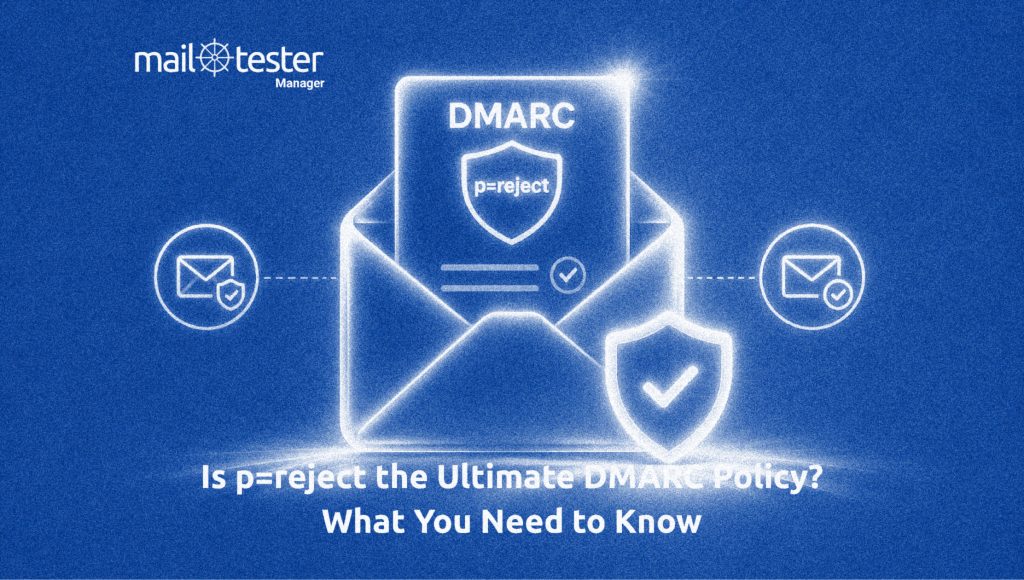
DMARC p=reject is the strictest policy a domain owner can apply in DMARC. It tells receiving mail servers to completely refuse emails that fail DMARC authentication checks. In simple terms, if an email pretending to come from your domain fails SPF, DKIM, or alignment checks, the receiving server will reject the message instead of delivering it.
This policy is designed to protect a domain from spoofing attacks. Attackers often try to send fraudulent emails that look like they come from a trusted domain. With DMARC policy p=reject, these unauthenticated emails are blocked before they ever reach the recipient’s mailbox.
Because it actively blocks suspicious messages, this policy is usually implemented only after a domain owner has carefully monitored their email ecosystem and confirmed that legitimate emails authenticate correctly.
Where p=reject Fits in the DMARC Policy Hierarchy
DMARC policies are typically implemented in stages. Each stage gives domain owners more control over how unauthenticated emails are handled.
- The first stage is p=none, which is used for monitoring. At this stage, no action is taken against failing emails. Domain owners simply collect DMARC reports to understand how their emails are being authenticated.
- The next stage is p=quarantine. Emails that fail authentication are treated as suspicious and are usually sent to the spam folder.
- The final stage is p=reject. This is the strictest policy because failing emails are completely refused by the receiving server and never delivered.
Why p=reject is Considered the Final Stage of DMARC
DMARC p=reject is often called the final stage of DMARC implementation because it represents full enforcement of email authentication. By the time a domain adopts DMARC policy p=reject, the organization has usually verified that all legitimate email sources are properly configured with SPF and DKIM. This ensures that authentic emails pass DMARC checks.
Before reaching this stage, most organizations spend time reviewing DMARC reports to identify all services that send email on their behalf. This step is important because marketing platforms, support tools, and internal systems must all be correctly authenticated. If any legitimate sender is missed, their emails could be rejected once strict enforcement begins.
Once this stage is reached, spoofed emails that attempt to use the domain will fail authentication and be rejected. The receiving mail server simply refuses to accept the message, which prevents it from reaching the inbox or spam folder. When configured correctly, this policy significantly reduces the risk of domain spoofing and phishing attacks and signals that the domain has a mature email authentication setup.
When Should Organizations Move to DMARC Policy p=reject?
Moving to DMARC policy p=reject is an important step in a domain’s email authentication journey. However, organizations should only take this step after carefully reviewing their email infrastructure and confirming that all legitimate messages are correctly authenticated. Since this policy blocks failing emails completely, applying it too early can lead to legitimate messages being rejected. Here are the ideal situations to apply this policy:
After SPF and DKIM are Fully Aligned
One of the most important requirements before implementing DMARC policy p=reject is making sure SPF and DKIM are properly aligned with the domain in the From address. Alignment means that the domains used for authentication match the visible sending domain used in the email header.
Every legitimate email source must pass at least one of these authentication checks with proper alignment. This includes company mail servers, cloud email providers, and any platforms that send emails on behalf of the organization. If alignment is not configured correctly, valid emails could fail DMARC and be rejected once enforcement begins.
When DMARC Reports Show Minimal Failures
Another clear signal that an organization is ready for strict enforcement is the pattern shown in DMARC aggregate reports. These reports provide visibility into which servers are sending emails using the domain and whether those emails pass authentication.
During the monitoring phase, organizations often discover unknown sources attempting to send emails from their domain. These sources may include outdated services, misconfigured tools, or unauthorized senders. Before moving forward, these sources should either be properly authenticated or removed. When reports consistently show very few authentication failures, it usually indicates that the email ecosystem is under control.
When all Third-Party Senders are Properly Configured
Many organizations rely on external services to send emails. These can include marketing platforms, CRM systems, support ticketing tools, and other SaaS mailing tools. Each of these services must be configured to authenticate emails correctly using SPF or DKIM.
If a third party sends emails without proper authentication, those messages will fail DMARC checks. Before implementing DMARC policy p=reject, organizations should confirm that every external service sending emails on their behalf is correctly configured and tested. This ensures legitimate communications continue to reach recipients without disruption.
Common Breakpoints When Implementing DMARC p=reject
Moving to DMARC p=reject can significantly strengthen email security, but it can also reveal hidden issues in an organization’s email ecosystem. Even when most systems are configured correctly, certain situations can cause legitimate emails to fail authentication. These issues often appear only after strict DMARC enforcement is applied. So, understanding the following breakpoints helps organizations prepare for them before switching to a reject policy:
Forwarding Services That Break SPF
Email forwarding is one of the most common reasons legitimate messages fail DMARC checks. When an email is forwarded from one mailbox to another, the message often passes through a different mail server than the one that originally sent it. Since SPF checks verify the sending server’s IP address, the forwarded server may not be listed in the domain’s SPF record.
As a result, SPF authentication can fail during forwarding. If the message does not have a valid DKIM signature that aligns with the sending domain, it may fail DMARC as well. This issue is frequently seen with mailing lists and with inboxes that automatically forward messages to another address. Without DKIM alignment, these forwarded emails may be rejected once a strict DMARC policy is active.
Misconfigured Third-Party Email Platforms
Organizations often rely on external platforms to send emails for marketing, customer notifications, or support communications. Problems can occur if these services are not configured to authenticate emails using the correct domain.
In some cases, vendors send emails using their own domain rather than the organization’s domain. In other situations, the platform may not apply a DKIM signature at all. If the message fails SPF alignment and lacks DKIM authentication, it will fail DMARC checks. When DMARC p=reject is enabled, these messages will be refused by the receiving server. Careful configuration and testing of each platform is necessary to avoid this problem.
Subdomain Authentication Issues
Subdomains can introduce additional complexity during DMARC enforcement. Some organizations send emails from subdomains while their DMARC policy is published on the parent domain. If authentication settings are not configured consistently, alignment failures may occur.
For example, an email might be sent from a subdomain while the DKIM signature uses the parent domain, or the other way around. In such cases, the authentication domain may not align with the visible From domain. These alignment issues can cause legitimate emails to fail DMARC once enforcement becomes strict.
Legacy Systems That Cannot Support DKIM
Older email infrastructure can also create challenges. Some legacy SMTP systems and internal tools do not support DKIM signing. Without DKIM, these systems rely entirely on SPF authentication.
If emails pass through intermediaries or forwarding services, SPF may fail even when the message is legitimate. Because these systems cannot generate DKIM signatures, they become vulnerable to DMARC failures under strict enforcement. Organizations may need to upgrade or replace such systems before safely implementing DMARC p=reject.
Using the pct Tag With DMARC p=reject
The pct tag in DMARC allows domain owners to apply their policy to only a percentage of failing emails instead of enforcing it on every message. When organizations move toward DMARC p=reject, the pct tag provides a controlled way to introduce strict enforcement without immediately affecting all email traffic.
The pct tag is written as pct= in the DMARC record and accepts values from 0 to 100. For example, a DMARC record with p=reject; pct=25 instructs receiving mail servers to reject only 25 percent of emails that fail DMARC checks. The remaining failing messages are treated as if the policy is not fully enforced.
When Should Organizations Use the pct Tag?
The pct tag is most useful during the transition to DMARC p=reject. Even after careful testing, organizations may still worry that a small number of legitimate emails could fail authentication. By applying the reject policy gradually, domain owners can observe real-world results while limiting potential disruption.
For instance, an organization might begin with pct=10 or pct=25 and monitor DMARC reports closely. If no legitimate emails are being rejected, the percentage can be increased step by step until the policy reaches full enforcement at pct=100.
How the pct Tag Helps Reduce Risk
The pct tag acts as a safety mechanism while implementing strict DMARC policies. It gives administrators time to detect hidden sending sources, configuration mistakes, or authentication gaps that were not visible earlier.
If any unexpected issues appear in DMARC reports, they can be corrected before the reject policy applies to all messages. This gradual approach allows organizations to move confidently toward full protection while maintaining normal email delivery for legitimate communications.
Final Thoughts on DMARC p=reject
Reaching DMARC p=reject is not just a technical milestone. It is a signal that a domain owner has gained full visibility into how their domain is used for sending email.
Many organizations stay in monitoring mode for years because their email ecosystem feels too complex to untangle. Marketing tools, customer platforms, internal systems, and forgotten services all send emails in the background. Moving toward enforcement requires identifying these sources, fixing authentication gaps, and bringing everything under control.
That effort is worth it. Once a domain reaches the p=reject stage, attackers lose one of their easiest tricks, which is sending emails that appear to come from a trusted domain. Instead of quietly reaching inboxes, those spoofed messages are blocked at the connection level.
In other words, DMARC p=reject turns email authentication from passive monitoring into active protection. For organizations that rely on email for business communication, brand trust, and customer interactions, that shift makes a meaningful difference.